English
 Pусский
 عربي
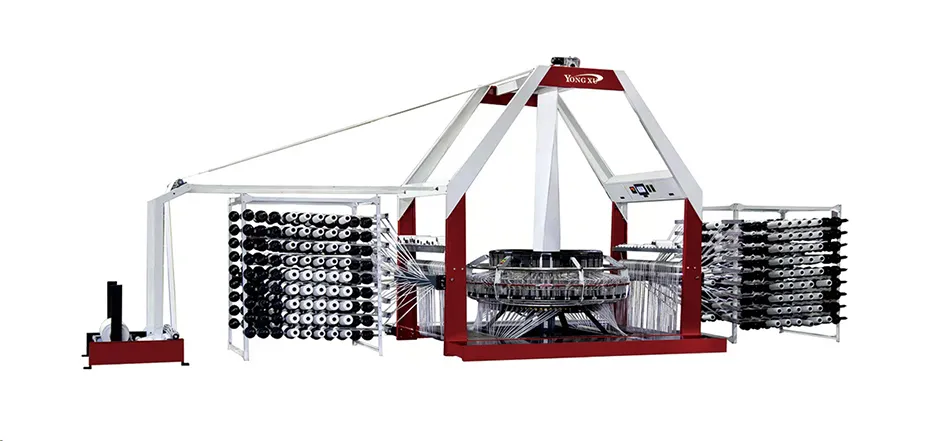
عربي Last week, a PP woven sack plant manager showed me two rolls of fabric. One was smooth, with perfectly even selvages; the other was riddled with thin spots and a wandering weft. The machines were the same model, run the same hours – but one consistently delivered 15% more output at a higher grade. When we opened the side guards, the difference became obvious. It wasn’t about the motor power or the brand name on the nameplate. It was about a handful of unseen components that silently dictate whether your circular loom runs like a finely tuned instrument or a source of daily headache.
If your production numbers fluctuate unpredictably, or you’re fighting recurring fabric defects, the root cause rarely lives in the whole assembly. Usually, it sits in four or five specific locations that deserve a much closer look. Understanding what to check first can save thousands of meters of waste and hours of troubleshooting.
The Shuttle & Picker Wheel: The Speed Governor Nobody Watches
The shuttle carries the weft thread and gets flung through the shed thousands of times per hour. Every gram matters. Traditional wooden shuttles absorb humidity, swell, and their surface friction changes during a single shift. That friction variability directly translates to speed instability and weft tension surges. Many operators compensate by increasing spring pressure on the picker wheel, which in turn accelerates wear on the wheel itself.
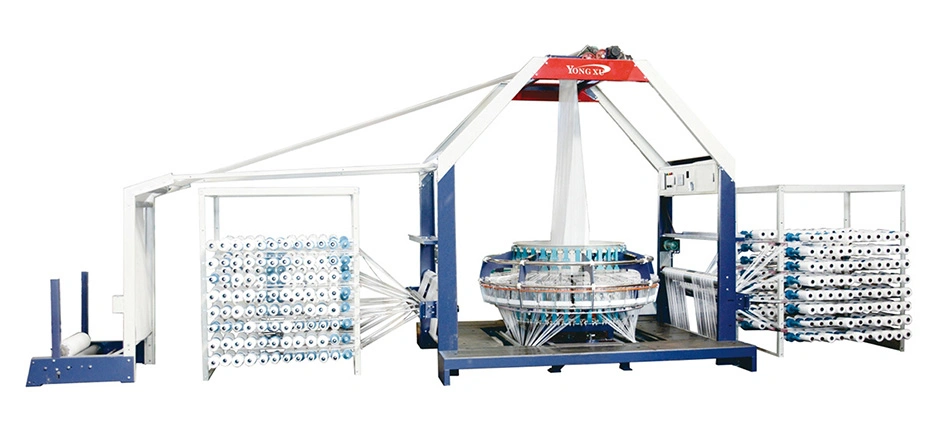
A critical upgrade that often gets overlooked is moving to engineered composite shuttles with a controlled coefficient of friction. In a side-by-side trial at a cement bag plant in Gujarat, switching from phenolic-wood shuttles to carbon-fiber reinforced ones reduced weft breakage by 30% and allowed a sustainable 8-10 rpm increase without raising the defect rate. The key mechanism is simple: when shuttle weight is reduced and surface properties remain stable, the cam profile can be optimized for speed. That’s where the next component comes into play. If you want to understand how the shuttle motion is harmonized with the entire weaving cycle, take a closer look at the advanced shuttle driving design that integrates light-weight shuttles and precisely angled pickers.
| Shuttle Material | Weight (g) | Weft Tension Variation | Typical Max Stable Speed (rpm) | Maintenance Interval |
|---|---|---|---|---|
| Pressed Wood/Phenolic | 220-250 | High, moisture dependent | 140-150 | Weekly shimming/adjustment |
| Engineering Plastic (PA) | 180-200 | Moderate, temp sensitive | 155-165 | Bi-weekly check |
| Carbon-fiber Composite | 150-170 | Low, very stable | 170-185 | Monthly inspection |
Data based on field reports from woven sack producers running 6-shuttle circular looms, 2023-2024. Your results may vary with denier and tape quality.
Cam & Raceway Geometry: The “Pulse” of a Circular Loom
If the shuttle and picker wheel are the limbs, the cam and raceway are the heartbeat. The cam profile determines the acceleration curve of the shuttle. A poorly machined or worn cam creates micro-collisions at the entry and exit of the shed, leading to the characteristic “clicking” sound that veteran mechanics dread. That shock doesn’t just hammer bearing surfaces; it momentarily spikes weft tension and can create a visible bar across the fabric every few meters – a defect that leads to downgrading of the entire roll.
The quality of the cam is all about the transition curve. Lower-end machines often use cams with simple circular arc profiles, which result in abrupt velocity changes. High-performance configurations use modified trapezoidal or polynomial curves, keeping the shuttle’s jerk (the derivative of acceleration) within bounds defined by ISO 15236 for conveyor belt fabrics, though the principle applies identically to woven packaging. When evaluating a machine, ask whether the cam track is hardened and ground, or merely milled. A surface hardness below HRC 58 on the raceway will show measurable step wear in under 5000 running hours, gradually worsening the fabric’s weft straightness. The cumulative effect is a machine that seems to “run fine” but quietly drifts out of spec. For a lasting solution, it’s worth examining a weaving system built around hardened, precisely ground cam tracks that maintain their profile over years of operation.
Warp Let-Off & Take-Up: The Invisible Tension Dialogue
Speed and quality cannot be discussed without talking about the warp let-off system and the fabric take-up. These two units are in constant “dialogue”: the let-off feeds warp tapes, the take-up pulls the finished fabric. If either side hesitates or surges, the result appears immediately as density variation, selvage curling, or uneven weft insertion.
The most troublesome scenario is the stick-slip effect in older friction-type let-offs. When the beam diameter changes as the warp unwinds, the braking force must be continuously adjusted manually or via a crude mechanical follower. At higher weaving speeds, the adjustment lag causes low-frequency tension oscillation – typically with a period of 5 to 15 seconds. You can see this in the fabric as a rhythmic heavy-light pattern. Modern systems using load-cell-based closed-loop control, as outlined in general textile machinery guidelines like ITMF’s benchmarking reports, can maintain tension within ±2% of setpoint even during loom acceleration and deceleration. This is particularly important for lighter denier tapes used in technical packaging, where a 5% tension spike can cause permanent tape elongation and reduced bag strength. Before settling for repeated manual intervention, consider what a precisely coordinated warp feed and fabric winding system can achieve in terms of unattended running time and roll consistency.
The Lubrication Factor You Cannot Skip
High-speed circular looms operate with hundreds of sliding and rolling contacts. Centralized automatic lubrication is not just a convenience – it is a prerequisite for sustained speed. In a manual greasing setup, a single missed zerk on a rocker shaft bearing can generate enough heat to change the local clearance. That clearance then alters the timing of the entire shed opening. I recall a case where a fabric lamination customer traced their intermittent coating delamination back to a 0.4mm timing shift caused by a slightly sloppy bearing, itself the result of irregular lubrication. The issue vanished after retrofitting a programmable oil metering unit.
Soft Landing: Where to Apply This Knowledge
Once you’ve identified which of these components is the bottleneck in your specific operation – be it shuttle inertia, cam wear, let-off hunting, or lubrication gaps – the next step is to decide whether to upgrade parts on an existing frame or to look for equipment that addresses these interactions at the design stage. The advantage of the latter is that the cam profile, shuttle mass, let-off control algorithm, and lubrication mapping are developed together, not stitched from separate aftermarket kits. If you’re aiming for a more professional setup that handles these variables cohesively, explore Yongxu’s configuration approach to these critical weaving sub-systems. It’s a direct way to see how a balanced specification can stabilize both your output rate and your fabric grade, without the trial-and-error of mismatched component upgrades.
Ultimately, the speed and quality you get from any circular weaving machine are not mysterious. They are decided by a short list of parts that rarely get the attention they deserve. Shifting your focus from the whole machine to these few components is the simplest way to unlock extra capacity that’s already sitting on your factory floor.