English
 Pусский
 عربي
عربي Last week, I visited a plant where the floor manager proudly showed me their output numbers. They were hitting quotas. But as I walked the line, I noticed the rhythmic thump-thump of the winder struggling to rewind a roll with visible gauge bands. Operators were hauling away barrels of edge trim that seemed far too heavy. The machine was running, but it wasn’t singing.
The realization hit him hard when we crunched the numbers: they were hemorrhaging nearly 12% of their raw material—a mix of LDPE and EVA—straight into the grinder. The issue wasn't the equipment's pedigree; it was a creeping tolerance for "standard" inefficiencies in the process parameters. If you’re running a complex melt delivery system, you might be leaving a significant amount of margin on the table simply because the settings haven't been revisited since installation.
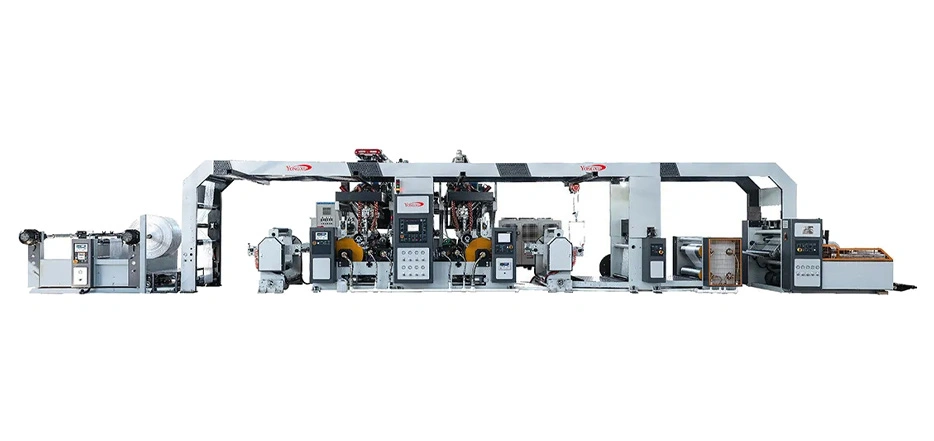
The truth is, a high-throughput extrusion coating line isn’t a "set and forget" asset. It’s a dynamic system. Moving from a 15-micron coating on kraft paper to a 25-micron barrier layer on aluminum foil requires more than just changing the substrate roll. It demands a recalibration of the thermal and mechanical profile. Let’s dissect where those hidden profit killers live and, more importantly, how to eliminate them through precise parameter tuning.
The Melt Curtain Instability: The Root of All Waste
The most visually obvious sign of trouble is a wavering melt curtain. You see it fluttering, narrowing, or exhibiting "edge weave" before it hits the nip. Many operators instinctively crank up the die temperature, hoping to thin the melt and stabilize the flow. This is a classic mistake that directly fights against your heat-seal performance.
We need to look upstream. Instability almost always starts in the screw’s metering zone. If the barrel temperature profile in Zone 3 is too flat, you lose viscosity control. I’ve seen operators raise the die temperature to 330°C to fix a wavering edge, only to degrade the polymer, causing smoke, odor, and weak heat seals. The fix was lowering the die temp by 15°C while increasing the pressure at the screen changer by adjusting the back-pressure valve. A stable melt curtain is rarely a function of higher heat; it’s a function of consistent pressure differential.
Decoupling Speed from Gauge Variation
A common fallacy in the industry is that you must sacrifice line speed for coating weight consistency. That’s outdated logic, often tied to old analog drive systems. On modern machinery, the key is decoupling the extruder RPM from the line shaft speed.
The goal isn't to run the screw at 100% capacity; the goal is to find the critical shear rate where the polymer’s molecular weight distribution isn’t being mechanically broken. If you’re running a material sensitive to shear, like certain metallocene PE grades, a slower, deeper-flighted screw profile combined with a higher pull-off speed through the primary cooling roll often doubles your throughput without a single micron of drift.
This is where the interaction between the air gap and the nip becomes critical. Shortening the air gap isn’t always the answer—it reduces neck-in but can increase oxidation if you’re doing chemical priming. The optimization trick is to tune the Nip Pressure Profile. If the pressure on the backside of the rubber roll is uneven, you’ll see "tram lines" on the web.
The Edge Bead Dilemma: Trim Recovery vs. Re-Extrusion
Edge bead (or neck-in) is unavoidable, but excessive edge bead is a self-inflicted wound. It’s almost always a back-pressure issue at the die lips. Instead of endlessly adjusting the deckle rods—which often causes a "dam" effect disrupting the edge flow—look at the internal deckle system.
If you are manually adjusting the outer deckles to try to catch a wandering melt, you’ve already lost control of the process. A precise internal deckle system allows you to pre-set the wet width digitally, reducing the heavy edge bead that forces you to trim 20mm on each side. Reducing trim from 20mm to 12mm per side on a 2.5-meter line saves roughly 6.4% material per linear meter. That isn't process optimization; that’s pure profit.
Case Study: The 18% Efficiency Leap
I recall a specific case involving a converter switching from woven polypropylene to a delicate PET nonwoven for medical packaging. The operation was plagued by burn-through and warping. The initial instinct was to lower the melt temperature, but that caused poor adhesion.
The breakthrough came when we ignored the temperatures and focused on the Corona Treater Positioning. We moved the treater from directly over the unwind (where it was pre-treating a dusty web) to directly in front of the nip entry. This "fresh treatment" allowed the melt to anchor instantly at a lower temperature. Simultaneously, we tuned the Chill Roll Temperature Gradient. Instead of a uniformly cold 15°C roll, we set an entry step of 22°C and an exit chill of 10°C. This annealed the PET just enough to stop warping without killing the clarity.
By shifting the focus from destructive heat to mechanical surface energy and staged thermodynamics, the line ran 18% faster with zero burn-through. For a deeper dive into the modular components that make these quick-change setups possible, see the detailed system breakdown here.
Preventive Tuning: The Weekly Five-Point Check
Don’t wait for the quality control lab to catch a failing heat seal. Every Monday, run this checklist:
-
Back Pressure Variance: At steady state, is the extruder head pressure fluctuating more than 2%? If yes, check screen pack loading or bridging in the hopper.
-
Nip Deflection: Place pressure-sensitive film across the nip width. Look for gaps indicating worn rubber or hydraulic imbalance.
-
Die Lip Carbonization: A tiny flake of charred polymer on the lip edge will carve a permanent line down your web. Clean the lips with a brass scraper, never steel.
-
Chill Roll Pitting: Run your hand (safely, with the line stopped) over the matte finish roll. Micro-pitting traps air, causing cloudy spots in the coating.
-
Temperature Override Log: Lock the PID controllers. If an operator overrides the setpoint to "fix" a transient issue, they are masking a bigger mechanical problem. Audit the override log ruthlessly.
When to Push, and When to Recalibrate
It's tempting to treat spec sheets as gospel. If the die manufacturer says the lip gap is 0.5mm, some engineers never touch it. But if you’ve changed your base resin’s melt index by more than 2 points, that gap needs a micro-adjustment.
Aggressive tuning isn't about red-lining your equipment. It's about restoring the thermodynamic equilibrium. Every time you introduce a recycled content stream (PCR), you alter the specific heat capacity of the blend. You’re no longer melting LDPE; you’re melting a blend with contaminants that have a different crystallization rate. Failing to adjust the cooling capacity accordingly is what leads to blocking on the winder.
This level of granular control requires a machine that gives you clean, repeatable data—not just a speed dial and a temperature gauge. If you are running a complex multi-layer barrier structure and feel like you’re flying blind, you likely need a control architecture upgrade. Explore a control interface built for granular recipe management.
Closing the Loop
The difference between a line that costs money and one that makes money isn’t the age of the motors; it’s the intelligence of the parameters. Next time you walk by the winder, look at the roll. The profile should be glass-smooth, the edges perfectly trimmed. If they aren’t, the machine is telling you something.
Fine-tuning isn't a one-time calibration; it's a daily discipline. Start tracking your specific energy consumption (kWh/kg) today. Small tweaks to barrel profiles and air gaps will manifest as massive savings over a fiscal quarter.
If you prefer to have a technical specialist walk through these variable speed drive and thermodynamics calculations for your specific substrates, feel free to reach out. Get a tailored assessment and recommended configurations for your next production upgrade.