English
 Pусский
 عربي
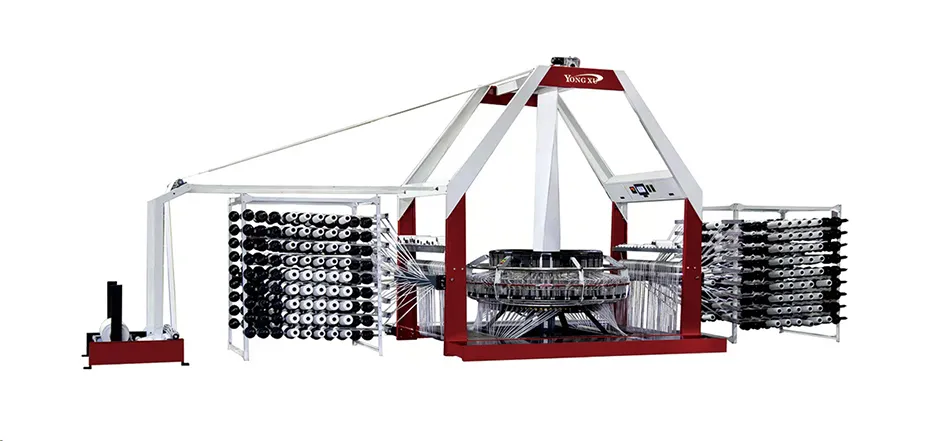
عربي In the previous article, we discussed why more and more people are choosing six-shuttle circular looms, analyzing their advantages in efficiency and cost. So, can four-shuttle circular looms be eliminated?
The answer is no. In the production of plastic woven bags, four-shuttle circular looms are not only not obsolete but continue to play an irreplaceable role in specific areas.
The unit price of a four-shuttle circular loom is significantly lower than that of a six-shuttle loom, which is a very practical advantage for startups and entrepreneurs with limited capital. Starting production with a small investment and gradually upgrading as orders grow is the path many successful enterprises have taken. This approach helps control initial risks while leaving sufficient financial room for future development.
The answer is no. In the production of plastic woven bags, four-shuttle circular looms are not only not obsolete but continue to play an irreplaceable role in specific areas.
The unit price of a four-shuttle circular loom is significantly lower than that of a six-shuttle loom, which is a very practical advantage for startups and entrepreneurs with limited capital. Starting production with a small investment and gradually upgrading as orders grow is the path many successful enterprises have taken. This approach helps control initial risks while leaving sufficient financial room for future development.
Moreover, four-shuttle circular looms have a unique advantage in raw material adaptability—they can run on 100% recycled materials, while six-shuttle circular looms typically can only use about 30% recycled content. This is because six-shuttle looms pursue high-speed operation, requiring higher flat yarn strength and tension uniformity. Impurities and performance fluctuations in recycled materials can easily lead to yarn breakage and machine stoppage. In contrast, four-shuttle circular looms operate at a relatively stable speed and have a larger tolerance margin in their track structure, making them more accommodating to different raw material qualities. For the plastic weaving industry, where raw material costs account for 70%-80% of total costs, being able to use low-cost recycled materials represents a significant cost advantage.
Therefore, in actual production, many factories adopt a "six-shuttle as main, four-shuttle as supplementary" configuration: using six-shuttle circular looms for large-volume orders of standard-sized products (using virgin materials), while using four-shuttle circular looms for producing extra-wide products or products with high recycled material content. Such a combination ensures efficiency while maximizing cost savings through the use of recycled materials.