English
 Pусский
 عربي
عربي When Rahul, a woven sack plant manager in Gujarat, sat down to review his quarterly numbers last year, one figure made his stomach turn: electricity. The power bill for his aging weaving department had crept up to nearly 28% of total production costs. His machines were running 24/7 churning out cement bags — but the margin per bag was shrinking month by month.
Rahul’s problem isn’t unique. Across the woven packaging industry, energy consumption has quietly become the biggest threat to profitability, outpacing even raw material price swings. If you’re running multiple weaving lines, a difference of just 1 kilowatt per hour per machine can translate into thousands of dollars lost — or saved — every year.
Why Do Some Weaving Lines Consume So Much Power?
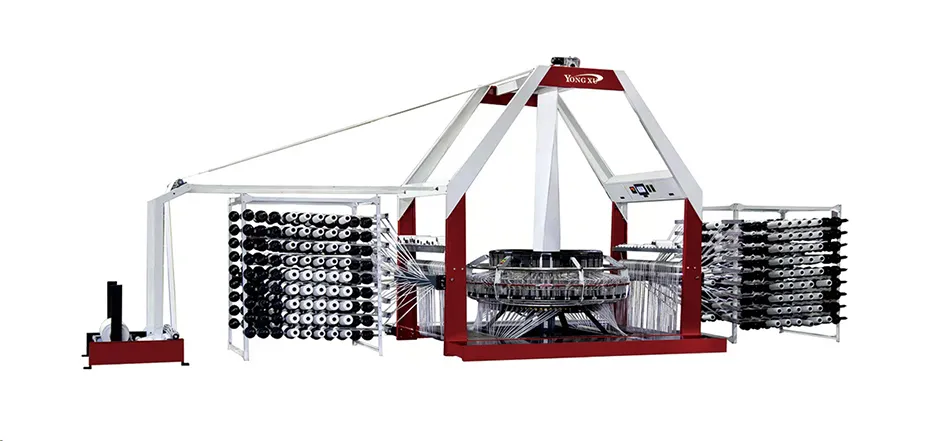
Before jumping to a fix, it’s worth understanding where the energy actually goes. In a conventional circular loom — the kind used for producing PP and PE tubular fabric — power draw typically ranges from 4.0KW to 5.5KW per hour depending on the model, shuttle count, and age of the equipment. The biggest culprits behind this consumption are:
-
Inefficient drive motors: Older AC motors running at fixed speed with no variable frequency control eat up energy even when the load fluctuates.
-
Mechanical friction in the cam and shuttle raceway: Poorly hardened or unpolished tracks generate resistance, requiring more torque — and more amps — to maintain weaving speed.
-
Oversized or outdated warp let-off and fabric take-up systems: These subsystems often use high-torque motors that aren’t optimized for the actual tension requirements of lightweight PP tape.
-
Heat dissipation losses: In some designs, a noticeable amount of input energy converts to heat rather than useful work, which also shortens component life.
Industry data backs this up. According to an energy audit guide published by the Bureau of Energy Efficiency (BEE) for the plastics processing sector, motor-driven systems in weaving plants often account for 70-85% of total site electricity use. Even a 15% reduction in specific energy consumption per unit of output can swing net margins by 3-5 percentage points — a massive shift in a commodity business like woven cement bag manufacturing.
What “3.0KW/Hour” Really Means for Your Bottom Line
Now, let’s make this tangible. Imagine a machine that draws a steady 3.0 kilowatts per hour under normal production conditions weaving standard PP fabric at a reasonable speed. How does that play out in real money?
Assume a plant operates 8,000 hours per year (that’s roughly 330 days with typical downtime), and the local industrial electricity tariff is $0.12/kWh. Compare a legacy 4.5KW unit to a modern low-consumption 3.0KW unit:
| Parameter | Conventional Circular Loom (4.5KW) | Yongxu-Circular Loom (3.0KW) |
| Power draw per hour | 4.5 kW | 3.0 kW |
| Annual energy use (8,000 hrs) | 36,000 kWh | 24,000 kWh |
| Annual electricity cost @ $0.12/kWh | $4,320 | $2,880 |
| Saving per machine per year | – | $1,440 |
That’s a single unit. A mid-size cement bag plant running 10 such machines saves $14,400 a year — enough to cover the salary of two skilled operators or to invest in additional quality control equipment. Over a typical 8-10 year machine lifespan, the cumulative saving can exceed the original purchase cost of the loom itself.
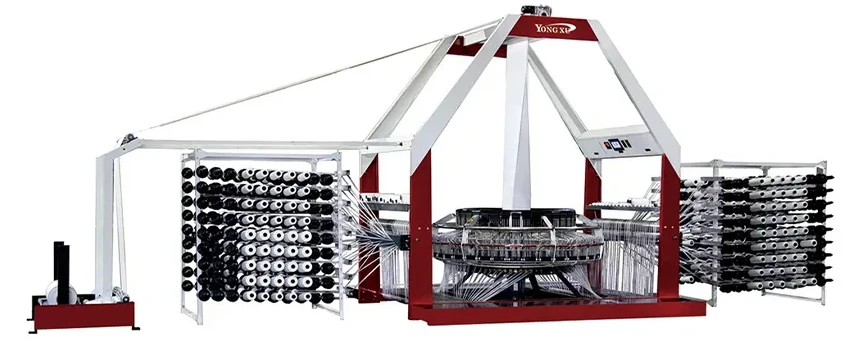
Of course, consumption figures must be verified. When evaluating low-consumption circular looms designed for PP woven fabric, always ask for the power reading at the rated weaving speed with a full set of shuttles loaded, not just the no-load motor rating. Reputable manufacturers will provide test reports showing real-time kW draw on a standard fabric specification — for example, 50-60 grams per meter tubular cloth at 450-500 picks per minute.
3 Technical Details That Make a 3.0KW Rating Possible
Achieving genuinely low power consumption isn’t about using a smaller motor. It requires re-engineering several core systems:
-
Permanent magnet synchronous motors (PMSM) or high-efficiency IE3/IE4 induction motors with VFD integration. These adjust torque output dynamically based on actual load demand. During shuttle change or slow-speed operation, the drive pulls significantly fewer amps than a fixed-speed setup.
-
Precision-ground cam tracks with advanced surface treatment. Reducing the coefficient of friction in the shuttle raceway directly lowers the mechanical work required per weft insertion cycle. This also reduces wear, keeping energy consumption stable over years rather than creeping up as components degrade.
-
Optimized shuttle design with reduced mass and balanced dynamics. Lighter shuttles carrying the same PP tape package weight demand less energy to accelerate and decelerate, which adds up over millions of cycles. Some modern systems also incorporate energy recovery circuits that feed braking energy back into the DC bus.
These aren’t laboratory gimmicks; they’re proven features that have been deployed in hundreds of installations. If you’d like to examine the specific engineering behind these savings, you can review the detailed specifications of a purpose-built low-consumption circular loom that incorporates all three principles.
How to Spot a Genuine Energy-Saver (And Avoid Fake Claims)
The market is full of “energy-saving” labels. Here’s a practical checklist to separate substance from marketing:
-
Ask for the test protocol. A legitimate low-consumption claim comes with a document stating the exact fabric width, denier, grammage, weaving speed, and number of shuttles used during the measurement. If the data sheet only mentions “installed motor power,” you’re not seeing the real picture.
-
Check the motor nameplate and drive brand. Reliable suppliers use internationally recognized motor and VFD brands with verifiable efficiency ratings. Obscure motors with no IE class marking are a red flag.
-
Inspect the cam and shuttle material. Hardened alloy steel cams with a mirror finish and shuttles with replaceable wear-resistant shoes indicate a design focused on minimizing frictional losses. Rough surfaces under a fingernail test signal higher long-term energy consumption.
-
Request field references. Talk to a factory that has run the same model for over 5,000 hours. Ask about their actual kWh per ton of fabric produced, not just the machine’s hourly kW. This metric — energy intensity per output — is the ultimate equalizer.
One common misconception is that reducing power means sacrificing output speed. Not necessarily. A well-designed low-consumption system achieves its savings primarily through efficiency gains, not by derating. In fact, some advanced models maintain 450+ picks per minute while staying under 3.2KW, thanks to the drive and mechanical optimizations described above. Before committing to a purchase, it’s worth comparing multiple energy-efficient configurations side by side to understand the real trade-offs (or lack thereof) between speed, fabric quality, and power draw.
From Rahul’s Desk: What Changed After the Switch
Let’s return to the plant in Gujarat. After replacing six of his oldest 5.2KW circular weaving machines with units running at a verified 3.0-3.1KW, Rahul tracked results over 18 months. The numbers:
-
Average monthly electricity bill for the weaving section dropped 31%.
-
Weaving defects per 100 meters of cement bag fabric decreased by 12%, which he attributes partly to the smoother cam mechanism and consistent warp tension control of the new equipment.
-
Machine downtime due to motor overheating (a frequent summer problem) vanished completely.
His maintenance team also reported a noticeable drop in shuttle wheel and raceway replacements, cutting annual spare parts cost by roughly $420 per machine. The lesson: energy efficiency rarely travels alone. It usually comes packaged with better mechanical precision and reliability.
If your operation is facing similar margin pressure, you don’t necessarily have to replace your entire fleet at once. Many plants start with one or two units, validate the performance using a sub-meter, and then phase replacements as older machines reach major overhaul milestones. For a closer look at what a modern low-consumption circular loom brings to the table — from frame rigidity to warp let-off precision — you can explore the full feature set of Yongxu’s dedicated line for PP/PE woven fabric and cement bag production.
A Final Word on Choosing Wisely
Electricity rates across major manufacturing regions — from South Asia to the Middle East to parts of Latin America — are trending upward as governments reduce industrial subsidies and invest in grid modernization. In parallel, buyers of cement bags, fertilizer sacks, and FIBCs are tightening their supply chain ESG requirements, including the carbon footprint embedded in each packaging unit. A machine that uses less power per kilogram of fabric doesn’t just save money; it becomes a tangible selling point when you bid for contracts with sustainability-conscious customers.
When you evaluate your next expansion or replacement cycle, consider asking vendors for a guaranteed specific energy consumption figure written into the purchase agreement. This shifts the conversation from “how many amps does the motor draw” to “how many kWh will I actually consume per ton of woven fabric produced” — and that’s the conversation that directly impacts your bottom line.
Disclaimer: This article presents general energy cost comparisons for illustrative purposes. Actual savings depend on local electricity tariffs, fabric specifications, operating practices, and machine configuration. Readers should conduct on-site measurements to validate performance claims for their specific production environment.